

Introduction: The Saltwater Etch Process

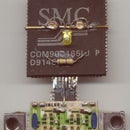


This is a one-off process to produce one printed circuit board by removing unwanted copper by electrolysis in a saltwater solution.
I shall illustrate the process by etching and building a board for 18-pin PIC (for the PC16F54, but any 18 pin PIC will fit in it) in the figure. It has to plug into my breadboard and accept the programming signals from my PIC programmer (just go to http://geocities.com/it2n/circuits.html and look at it).
To avoid battling with signal conflicts, the two programming pins shall not be brought to the breadboard. To play around with the clock frequency, the crystal shall be made pluggable. The Master clear signal will not be brought out.
These decisions mean a board with two .1" pitch connectors, one with 13 connections and the other with five connections, one pin spaced apart from the rest.
This is a tutorial intended for the absolute beginner, and almost every step shall be illustrated. I've even included a video of the etching process.
Step 1: Decide How Large the Board Has to Be

From the diagram, the side that plugs into the breadboard has 13 connections, and the holes in the bb are spaced 0.1 inch apart. So we need at least 1.3 inches to accommodate 13 pins.
Say one and a half inches, a nice figure. Take a piece of copper clad board larger than 1.5 inches a side. Draw a line at one and a half inches.
Step 2: Score a Line on the Copper

Hold your ruler or straightedge firmly down on the board. Hold a knife lightly and draw across the line many times.
After some time, there will be a gouge on the copper, dividing it into two.
If you bear down with the knife, chances are that it might wander and cut the board deeply where you do not want it cut - and you will be looking ruefully down on your ruined PCB stock. Be patient. Being patient has its own virtues, as life will invariably teach you.
Step 3: Make That Line a Deeper Groove

Now, you can take the ruler away and with a little more pressure on the knife, go over the line a few more times. It will be guided by the cut, and you need a groove on that side.
Then at each edge, mark the plain surface of the board and draw a line there, too, exactly on the other side.
Step 4: Score the Other Side

Now you need a groove on the other side of the laminate, too.
You will have a board with grooves on both the sides, and bending it with the fingers will be sufficient to cause it to break neatly at this line.
This is the copper side, with a deep groove.
Step 5: Groove on the Plain Side

This is the plain side of the laminate, with that deep groove.
Step 6: Break It Apart

If you look at the edge, you will see that the two grooves on the top and bottom of the sheet has made it weak at the line and it will break easily.
Step 7: The Cut Piece of PCB Laminate

So we have cut the laminate to about one and a half inches. It is actually a bit more than that, and that is for allowances in finishing.
It will need to be sanded down to make those edges smooth and that will take away a bit of material.
Step 8: Decide How Large It Has to Be

Now we have to decide how large the board has to be on the other dimension.
We need the two connectors, the PIC, the crystal, and some capacitors and one resistor.
Arranging them all on the board, it seems that about 2" will be sufficient.
Step 9: Clean the Board

Remove rough edges of the board using a sandpaper (Or go out and rub it on a level rough cement surface).
Clean the copper surface using an abrasive cleaning pad - the one I use is intended for use in the kitchen, and copper is toxic so do not relocate it to the kitchen after you have used it - it would also be a good idea not to borrow the one in the kitchen for this purpose.
Step 10: The Cleaned Board

I have cleaned about two inches of the board. The board will be cut to size after etching, as the extra length serves as a handle to hold the board.
The cleaned board will have a rough surface due to the scratching action of the abrasive pad, and this helps the board retain the etch resist better.
Step 11: Apply Etch Resist

Now you paint the area with some etch resist.
It can be any paint - it has to hold together under water, that's all. Permanent marker comes in an easy to apply form, and that is what I use.
You can use nail polish, though fancy brands may be too expensive.
You need a thorough thin coat, one which can be scratched away in a thin line.
A thick coat is likely to pull away in flakes when you attempt to score lines on it.
Step 12: Mark the Position of the Component Leads

Now, you have to mark the position of the leads of the major components. It is best to use the actual component itself as the template.
I have clamped the 16F54 to the board with two clipodile crocs. Mark the position of every pin, and you can lift each alligator in turn to mark underneath it.
Step 13: Draw Around the Pads With a Sharp Instrument

After you have marked the positions of the ic pads, and removed the ic, there will invariably be a few spots where the resist has rubbed off.
Repair them with a dab of the same stuff, and continue on to the next step: outlining the pads.
Use a clear transparent ruler and something with a sharp point to draw the outline of the pads. Refer to the layout you have prepared earlier.
You should think of separating point A from point B by drawing a line between them.
The conventional approach is to link point A to point B by drawing a line connecting them.
My approach helps to keep the maximum amount of copper on board, and minimises the amount of material to be removed.
This is important, otherwise the etching process will be too slow.
Step 14: Draw the Rest of the Circuit In

Once you have completed the pad pattern for the main component, you can draw in the rest of the connections.
I used a bit of veroboard as template for the .1" spacing, and placed the rest of the cuts as per the layout in the diagram.
Step 15: Errors Can Be Corrected

Any changes can be made to the layout at this stage.
Just paint over the scratches, and you have a fresh canvas to practise your art.
Now I decided that the board can be made more compact if the programming socket is relocated, so it was done.
One final necessary step is to place dots of paint so that all pads are connected together - this is necessary for electrolysis.
In my board, the pads are all connected along the left and bottom edges. The scratches in the paint stop short of the edge. They will be cut apart after the etching is completed.
Now the board is ready to be etched.
Step 16: The Etching Tank

You see here my etching tank (stands a while in reverence, head uncovered).
It is plastic, transparent, and has parallel sides, and is large enough to accommodate the board.
Also pictured is the negative electrode. A thick copper wire will do. I've used a straightened paper clip, but it tends to introduce rust into the solution. Almost any metal wire will work here.
Step 17: The Etch Tank Setup

It is useful to have a light shining on the other side of the board, as the light shining through the etched portion will allow you to see the progress of the etch.
I should recommend that you do not set this up close to your keyboard as the salt solution is corrosive if it gets into electronic equipment.
It is also helpful to have a tweety bird watching over you. In fact, I shall disclaim all responsibility if you do not have a twee ...
Step 18: Alternative Tank

In fact, the board proved too big for my regular tank so I used a plastic bag just large enough to hold the board as the etching tank.
This had the advantage of requiring even less of the etching solution.
The etching solution is made by dissolving as much salt as possible in water.
Step 19: Etching the Board

To etch the board, you make up a saturated solution of salt water, make the board positive and immerse it into the solution together with a negative electrode.
A 12 volt supply capable of supplying about 500 milliamperes is sufficient. Wire it in series with a filament lamp, say 12V, 6W, for an indication of the current.
It would take about five minutes for the etching process to be completed. You will be able to watch its process by the light shining through the gaps that open up as the copper gets eaten away.
Bubbles of hydrogen will be seen rising from the negative electrode. If they are rising from the copper, you have connected up the supply backwards and your wire is being eaten up.
To make up the salt solution, you take some water and dissolve as much salt as possible, thus making up a saturated solution. You add a little salt, shake it and watch the salt disappear as it goes into solution. Then you add some more, and it too disappears.
After some of this the salt will stop dissolving however much you shake and mix it, and at this point you have the saturated salt solution you need.
This is a saturated solution of Sodium chloride in Dihydrogen Monoxide. See http://www.dhmo.org for more information in handling this potentially hazardous substance.
Attachments

Step 20: The Etched Board

You see here the board after etching and cleaning. The paint can prove somewhat difficult to remove. You will need to use an appropriate solvent for the etch resist you have used.
Or you can use the abrasive pad to rub the paint off.
It might also be possible to leave the paint on the board, and remove it only where it is needed to solder. In this case it might produce toxic fumes while being soldered.
You will notice that all the traces are joined together, these will have to be cut apart before the board can be tested.
Step 21: Testing the Board for Short Circuits

After the traces are cut apart it is essential to test that there are no connections between adjacent areas.
You may use a 12V lamp connected to the same supply as used for electrolysis for testing. Or the way I do it - use a 12V, 15A supply together with a car headlamp for indication. Small shorts that used to be there get vapourised, and if that lamp lights up, boy, that really IS a short circuit.
For clearing the short circuits just run the sharp point of a knife through the lines. Angle it one way in one pass, and the other way in the next pass, and any copper still in there will just lift and crumble away.
Step 22: Drill Holes

Holes have been drilled to accommodate the sockets for the crystal and the programming interface.
Step 23: The Sockets

The figure shows two views of a turned pin integrated circuit socket. It is made of pins, machined from bar stock, molded into plastic.
We need to liberate the pins from the plastic. Heat the pin carefully until the plastic softens (but does not melt) and pull the pin free. We need seven of those pins.
Step 24: Crystal Socket

Then you cut their tails off and insert them into the holes and solder. You have a compact socket, with the PCB itself being part of the assembly.
I have a closeup of the crystal mounting so that you can see the details.
It is possible to grind away some of the rear end of those pins in order to reduce height. The part which actually makes contact is the spring inserted inside the hollow pin, and you can grind away quite a lot of material without damage to the internal working parts of the pin sockets.
Step 25: Mount the Components

The components have been soldered on to the board:
The seven pins making up crystal and programming sockets.
Two capacitors around the crystal
A 10K resistor pulling up the MCLR line to Vdd
A supply decoupling capacitor across Vss and Vdd
Two links have been soldered into place, and one more has to be fitted.
The lands for fitting the integrated circuit have been coated with solder prior to fitting it in position.
Step 26: Mount the Integrated Circuit

The ic is mounted last of all, in order to minimise chances of damage to it.
It is first placed in proper position and one corner pin heated with the soldering iron. Since there is a small amount of solder on the board, this melts and holds the ic in position.
Then the diagonally opposite pin is soldered, after making any slight adjustments in position as needed.
With the two corners soldered, the ic will be held firmly in place and so the rest of the leads are soldered.
This completes assembly of the board, and it may be tested by loading a "LED Blink" program or something.
I have soldered a Microchip PIC16F54 on this board, but this board will work with any eighteen pin PIC as well.
Some of the more advanced chips permit using the MCLR pin as an input so this might also have to be brought out to the edge.
Step 27: The Completed Board

The board is now complete.
It is compared with the original plan. I have made a few changes, mainly because it was simpler to route the traces that way.
It is essential to record changes because of the possibility of confusion later when using the board.
In this case, some traces pass under the chip and it is not easy to ascertain the order of the signals at the edge just by looking.
Documentation is essential and will take the form of signal names written right on top of the signal lines.
To make a second board you have to do all this all over again - This process is recommended only if you are making a single piece of a circuit, for which conventional prototyping methods are inconvenient.
I hope all this has been useful to someone out there.
I hope to be seeing a few projects on hand carved, salt water etched boards here in instructables in the near future.
Have Fun

Participated in the
The Instructables Book Contest